Honestly,
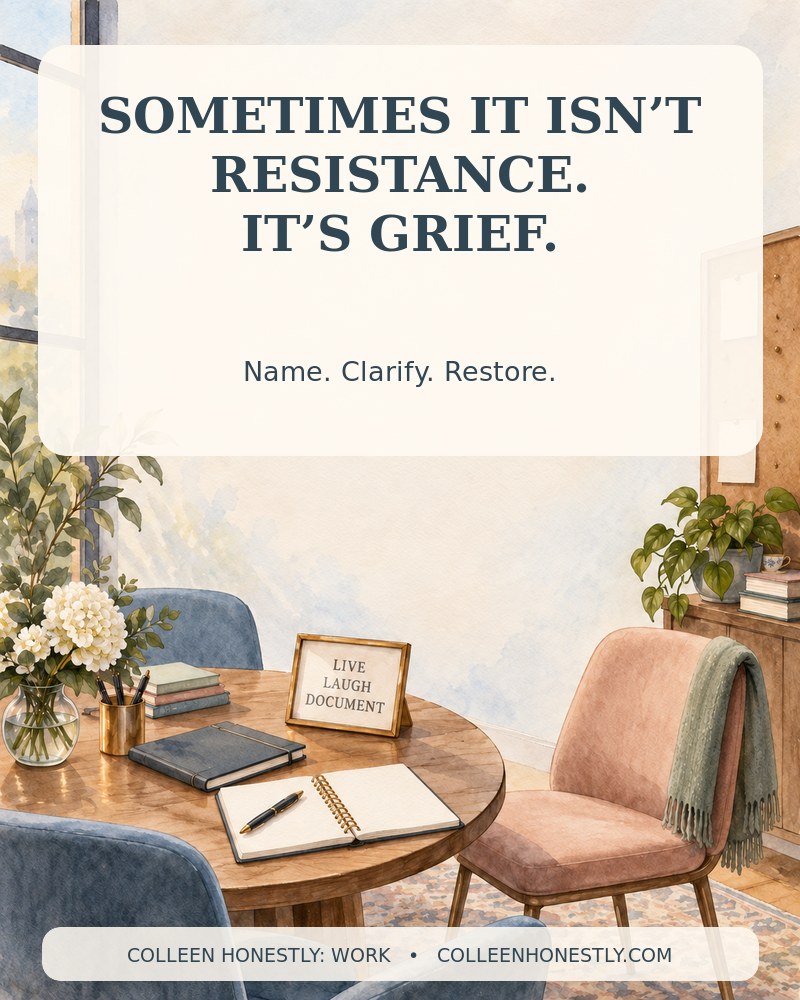
Sometimes what looks like resistance to change is grief wearing a work badge.
There is no funeral for the team that no longer exists.
Nobody sends a sympathy card when the leader you trusted leaves, the work you were proud of disappears, or the role you finally felt confident doing changes overnight.
No one shows up at your desk with hotdish and bars after a reorganization.
But something was still lost.
People may be grieving relationships, routines, influence, stability, expertise, or the future they thought they were building. Then the announcement arrives with a polished slide deck, several uses of the word exciting, and an expectation that everyone will immediately face forward.
People can understand why a change is happening and still be sad about what it costs them.
They can support the decision and miss what existed before it.
They can be capable of moving forward and need a moment to recognize what ended.
That isn’t necessarily resistance. It may be organizational grief.
Acknowledging that grief does not mean reversing the decision or pretending change can be painless. It means telling the truth: something is beginning, and something else is ending.
Leaders do not have to fix every feeling. But they can name the loss, explain what is known, admit what is not known, and give people some influence over what happens next.
Sometimes the most trustworthy sentence in a change conversation is:
“I know this is necessary, and I also understand that it is hard.”
Both things can be true.
Research has connected organizational change with uncertainty, stress, and workplace psychosocial risks. Transparent communication can help reduce uncertainty and support healthier coping during change. (BMC Public Health; Public Relations Review)
Reflections
- What has actually been lost—not just what has technically changed?
- Are we calling people resistant before giving them enough information or time to process?
- What can we preserve from the old way, even if the larger change cannot be undone?
From the toolbox: Name, clarify, restore
- Name the loss. Say plainly what people are leaving behind instead of speaking only about the future.
- Clarify reality. Separate what is decided, what remains uncertain, and when people can expect another update.
- Restore some control. Give people a meaningful choice, question, or decision they can still influence.
Try this:
“This decision is final, but I don’t want to minimize what it changes for this team. Here is what we know, here is what we are still working through, and here is where your input can shape what happens next.”
People do not need leaders to manufacture enthusiasm for every change.
Sometimes they need someone willing to tell the truth about what was lost—and help them find their footing in what comes next.
I hope you found this helpful, and if you did and know someone who might enjoy it, please feel free to share.